

'%3e%3cpath%20id='Vector'%20d='M4.83105%200.720662C4.60547%200.17574%204.01074%20-0.114299%203.44238%200.0409743L0.864258%200.744099C0.354492%200.884724%200%201.34761%200%201.87496C0%209.123%205.87695%2015%2013.125%2015C13.6523%2015%2014.1152%2014.6455%2014.2559%2014.1357L14.959%2011.5576C15.1143%2010.9892%2014.8242%2010.3945%2014.2793%2010.1689L11.4668%208.99703C10.9893%208.79781%2010.4355%208.93551%2010.1104%209.33687L8.92676%2010.7812C6.86426%209.80562%205.19434%208.1357%204.21875%206.0732L5.66309%204.89254C6.06445%204.56441%206.20215%204.01363%206.00293%203.53609L4.83105%200.723592V0.720662Z'%20fill='white'/%3e%3c/g%3e%3cdefs%3e%3cclipPath%20id='clip0_4_624'%3e%3crect%20width='15'%20height='15'%20fill='white'/%3e%3c/clipPath%3e%3c/defs%3e%3c/svg%3e)
'%3e%3cpath%20id='Vector'%20d='M17.74%2030.5L16%2029.5L20%2022.5H26C26.5304%2022.5%2027.0391%2022.2893%2027.4142%2021.9142C27.7893%2021.5391%2028%2021.0304%2028%2020.5V8.5C28%207.96957%2027.7893%207.46086%2027.4142%207.08579C27.0391%206.71071%2026.5304%206.5%2026%206.5H6C5.46957%206.5%204.96086%206.71071%204.58579%207.08579C4.21071%207.46086%204%207.96957%204%208.5V20.5C4%2021.0304%204.21071%2021.5391%204.58579%2021.9142C4.96086%2022.2893%205.46957%2022.5%206%2022.5H15V24.5H6C4.93913%2024.5%203.92172%2024.0786%203.17157%2023.3284C2.42143%2022.5783%202%2021.5609%202%2020.5V8.5C2%207.43913%202.42143%206.42172%203.17157%205.67157C3.92172%204.92143%204.93913%204.5%206%204.5H26C27.0609%204.5%2028.0783%204.92143%2028.8284%205.67157C29.5786%206.42172%2030%207.43913%2030%208.5V20.5C30%2021.5609%2029.5786%2022.5783%2028.8284%2023.3284C28.0783%2024.0786%2027.0609%2024.5%2026%2024.5H21.16L17.74%2030.5Z'%20fill='white'/%3e%3cpath%20id='Vector_2'%20d='M24%2010.5H8V12.5H24V10.5Z'%20fill='white'/%3e%3cpath%20id='Vector_3'%20d='M18%2016.5H8V18.5H18V16.5Z'%20fill='white'/%3e%3c/g%3e%3cdefs%3e%3cclipPath%20id='clip0_4_634'%3e%3crect%20width='32'%20height='32'%20fill='white'%20transform='translate(0%200.5)'/%3e%3c/clipPath%3e%3c/defs%3e%3c/svg%3e)





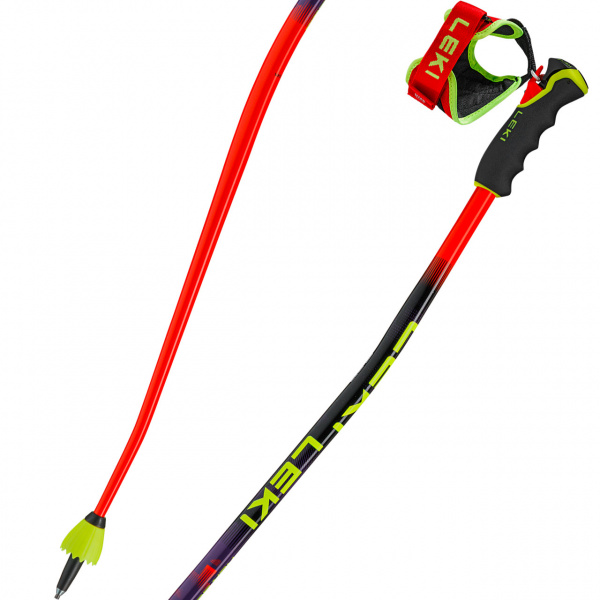


Downhill Poles - Maximum aerodynamics and stability
When every hundredth of a second counts on the downhill, Poles are a decisive factor for your performance. With a Lange, ergonomically curved design and
Purpose, Scope and Requirements
Downhill Poles are specially developed for the high speeds and dynamic movements of racing. They are primarily used in disciplines such as downhill and super-G, where precise cornering technique, a firm body position and consistent control are essential. The longer poles compared to slalom or giant slalom models allow a powerful turn initiation and help to stay as close to the body as possible in the aerodynamic racing position. Ergonomic grips and flat plates also minimize vibrations and prevent unnecessary air resistance so that you remain in control even on icy sections of the course.
Important properties, values and technical features
| Material | Very light, high rigidity | Robust, slightly heavier, inexpensive |
| Lange | Individually customizable | Standard lengths |
| Plate size | Extra flat for minimal air resistance | Small plates for good stability |
| Curvature | Pronounced curve for close body guidance | Easier bend, ideal for beginners |
| Handle | Ergonomic with rubber inserts | Standard handle, easy to grip but simpler |
| Loop | Aerodynamically flat, flexible | Classic loop, stable hold |
| Weight | 180-200 g per stick | 220-260 g per stick |
| Stability | Highest torsional rigidity | Good stability, tolerant |
| Aerodynamics | Maximum wind slip rate | Balanced between drag and control |
The way to your perfect downhill Poles
- Determine your height and pole length
Measure your height and choose a pole that reaches approximately to armpit height. Add another 5-10 cm as required. - Check material selection
Opt for carbon if you are looking for minimum weight and maximum stiffness. Aluminum poles are more robust and cheaper, but offer slightly less precision. - Test ergonomics and grip comfort
Look out for soft, non-slip grips and comfortable hand loops. They prevent blisters and ensure a secure grip even under heavy loads. - Compare bend and cup size
A pronounced bend brings you closer to the racing position. Flat, small plates reduce wind resistance. - Compare Markers and models
Try out different renowned manufacturers - whether Leki, Swix or KV+ - and find out which system grip and strap concept suits you best. - Weigh up budget and frequency of use
For ambitious competitors, it is worth investing in high-end models, while recreational racers are well served with a mid-priced aluminum set. - Final practical test
Test your favorites on a training track or in a ski resort to experience the handling and aerodynamics under real conditions.
At XSPO, you benefit from personal advice from winter sports experts who are out on the slopes themselves every day. Our extensive range includes downhill Poles for all ambitions - from beginners to professional racers - so that you can find exactly the right equipment to suit your style and budget.
Frequently asked questions about downhill Poles
- Which downhill Poles length suits my height?
The ideal length exceeds the distance from the ground to your armpit by 5 to 10 cm, depending on how deep you get into the racing position. - Which material is best for downhill Poles?
Carbon offers the best balance of lightness and stiffness, while aluminum is more robust and less expensive. - How effective are flat plates for downhill Poles?
Flat plates reduce drag considerably, but can provide less lift in soft snow. - Which brand of downhill Poles is recommended?
Well-known brands such as Leki, Swix and KV+ offer different grip and strap concepts, depending on your preference. - How do I look after my downhill Poles properly?
Clean poles and handles after every tour, check plates and loops for damage and tighten screw connections as required. - Can I also use downhill Poles for Super-G?
Yes, the requirements are very similar - just pay attention to the optimal length and bend for your riding style. - How do I find the right grip size for downhill Poles?
Wrap the loop around your hand and hold the handle - your thumb should be straight and relaxed. - At what temperatures are downhill Poles most robust?
High-quality carbon and aluminum alloys can also withstand extreme cold loads, but you should pay attention to the manufacturer's specifications. - Can I have my downhill Poles repaired?
Many specialist dealers offer retrofitting of handles and loops or the replacement of plates.
Downhill Poles - Maximum aerodynamics and stability
When every hundredth of a second counts on the downhill, Poles are a decisive factor for your performance. With a Lange, ergonomically curved design and
Purpose, Scope and Requirements
Downhill Poles are specially developed for the high speeds and dynamic movements of racing. They are primarily used in disciplines such as downhill and super-G, where precise cornering technique, a firm body position and consistent control are essential. The longer poles compared to slalom or giant slalom models allow a powerful turn initiation and help to stay as close to the body as possible in the aerodynamic racing position. Ergonomic grips and flat plates also minimize vibrations and prevent unnecessary air resistance so that you remain in control even on icy sections of the course.
Important properties, values and technical features
| Material | Very light, high rigidity | Robust, slightly heavier, inexpensive |
| Lange | Individually customizable | Standard lengths |
| Plate size | Extra flat for minimal air resistance | Small plates for good stability |
| Curvature | Pronounced curve for close body guidance | Easier bend, ideal for beginners |
| Handle | Ergonomic with rubber inserts | Standard handle, easy to grip but simpler |
| Loop | Aerodynamically flat, flexible | Classic loop, stable hold |
| Weight | 180-200 g per stick | 220-260 g per stick |
| Stability | Highest torsional rigidity | Good stability, tolerant |
| Aerodynamics | Maximum wind slip rate | Balanced between drag and control |
The way to your perfect downhill Poles
- Determine your height and pole length
Measure your height and choose a pole that reaches approximately to armpit height. Add another 5-10 cm as required. - Check material selection
Opt for carbon if you are looking for minimum weight and maximum stiffness. Aluminum poles are more robust and cheaper, but offer slightly less precision. - Test ergonomics and grip comfort
Look out for soft, non-slip grips and comfortable hand loops. They prevent blisters and ensure a secure grip even under heavy loads. - Compare bend and cup size
A pronounced bend brings you closer to the racing position. Flat, small plates reduce wind resistance. - Compare Markers and models
Try out different renowned manufacturers - whether Leki, Swix or KV+ - and find out which system grip and strap concept suits you best. - Weigh up budget and frequency of use
For ambitious competitors, it is worth investing in high-end models, while recreational racers are well served with a mid-priced aluminum set. - Final practical test
Test your favorites on a training track or in a ski resort to experience the handling and aerodynamics under real conditions.
At XSPO, you benefit from personal advice from winter sports experts who are out on the slopes themselves every day. Our extensive range includes downhill Poles for all ambitions - from beginners to professional racers - so that you can find exactly the right equipment to suit your style and budget.
Frequently asked questions about downhill Poles
- Which downhill Poles length suits my height?
The ideal length exceeds the distance from the ground to your armpit by 5 to 10 cm, depending on how deep you get into the racing position. - Which material is best for downhill Poles?
Carbon offers the best balance of lightness and stiffness, while aluminum is more robust and less expensive. - How effective are flat plates for downhill Poles?
Flat plates reduce drag considerably, but can provide less lift in soft snow. - Which brand of downhill Poles is recommended?
Well-known brands such as Leki, Swix and KV+ offer different grip and strap concepts, depending on your preference. - How do I look after my downhill Poles properly?
Clean poles and handles after every tour, check plates and loops for damage and tighten screw connections as required. - Can I also use downhill Poles for Super-G?
Yes, the requirements are very similar - just pay attention to the optimal length and bend for your riding style. - How do I find the right grip size for downhill Poles?
Wrap the loop around your hand and hold the handle - your thumb should be straight and relaxed. - At what temperatures are downhill Poles most robust?
High-quality carbon and aluminum alloys can also withstand extreme cold loads, but you should pay attention to the manufacturer's specifications. - Can I have my downhill Poles repaired?
Many specialist dealers offer retrofitting of handles and loops or the replacement of plates.